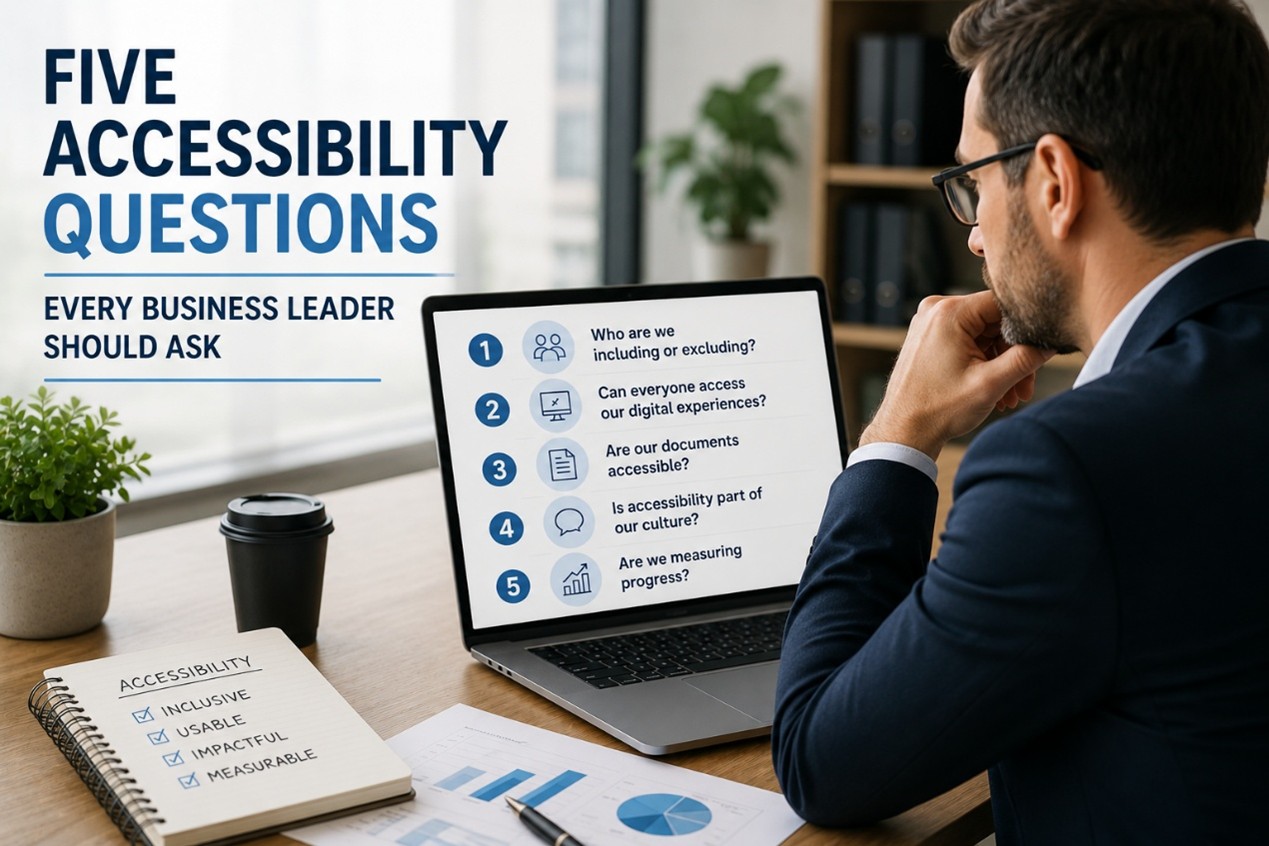
Five Accessibility Questions Every Business Leader Should Ask
Accessibility is often viewed as a technical issue, but the most successful accessibility initiatives start with leadership. Business leaders play a critical role in creating inclusive environments for customers, employees, and stakeholders.
By asking the right questions, leaders can identify gaps, reduce barriers and ensure accessibility becomes part of their organization's culture.
1. Can Everyone Access Our Products and Services?
Consider how customers interact with your organization. Can they navigate your website, complete online forms, access documents, and use digital services independently?
Accessibility barriers can prevent potential customers from engaging with your business. Regular accessibility reviews help identify issues before they become obstacles.
Action: Conduct an accessibility audit of your website, documents, and customer-facing systems.
2. Do We Include Accessibility in New Projects?
Many organizations address accessibility only after problems are identified. This approach is often costly and time-consuming.
Accessibility should be considered from the beginning of every project, whether developing a website, purchasing software, creating marketing materials or designing customer services.
Action: Add accessibility requirements to project planning and procurement processes.
3. Are Our Employees Equipped to Create Accessible Content?
Even with accessible systems in place, barriers can be introduced when employees create documents, presentations, videos or online content without considering accessibility.
Providing basic accessibility awareness training can significantly improve the quality of content produced across the organization.
Action: Offer practical training on accessible documents, presentations and digital communication.
4. Do We Listen to Accessibility Feedback?
Customers and employees often identify accessibility barriers before organizations do. Creating clear channels for feedback demonstrates a commitment to continuous improvement.
Feedback should be treated as valuable insight rather than criticism.
Action: Establish a simple process for reporting and addressing accessibility concerns.
5. Is Accessibility Part of Our Organizational Culture?
Accessibility is most effective when it becomes a shared responsibility. It should not be assigned solely to IT or compliance teams.
Organizations that embed accessibility into their culture are more likely to create inclusive experiences and maintain accessibility over time.
Action: Discuss accessibility regularly during leadership meetings and include it in organizational goals.
Accessibility is not achieved through a single project or annual review. It is an ongoing commitment that requires leadership, collaboration and accountability.
By regularly asking these five questions, business leaders can move beyond compliance and create environments where more people can participate, contribute, and succeed.