Smart Cyprus, AI and IoT: Strategic Digital Transformation, EU Funding and Digital Policy Beyond the Sensors
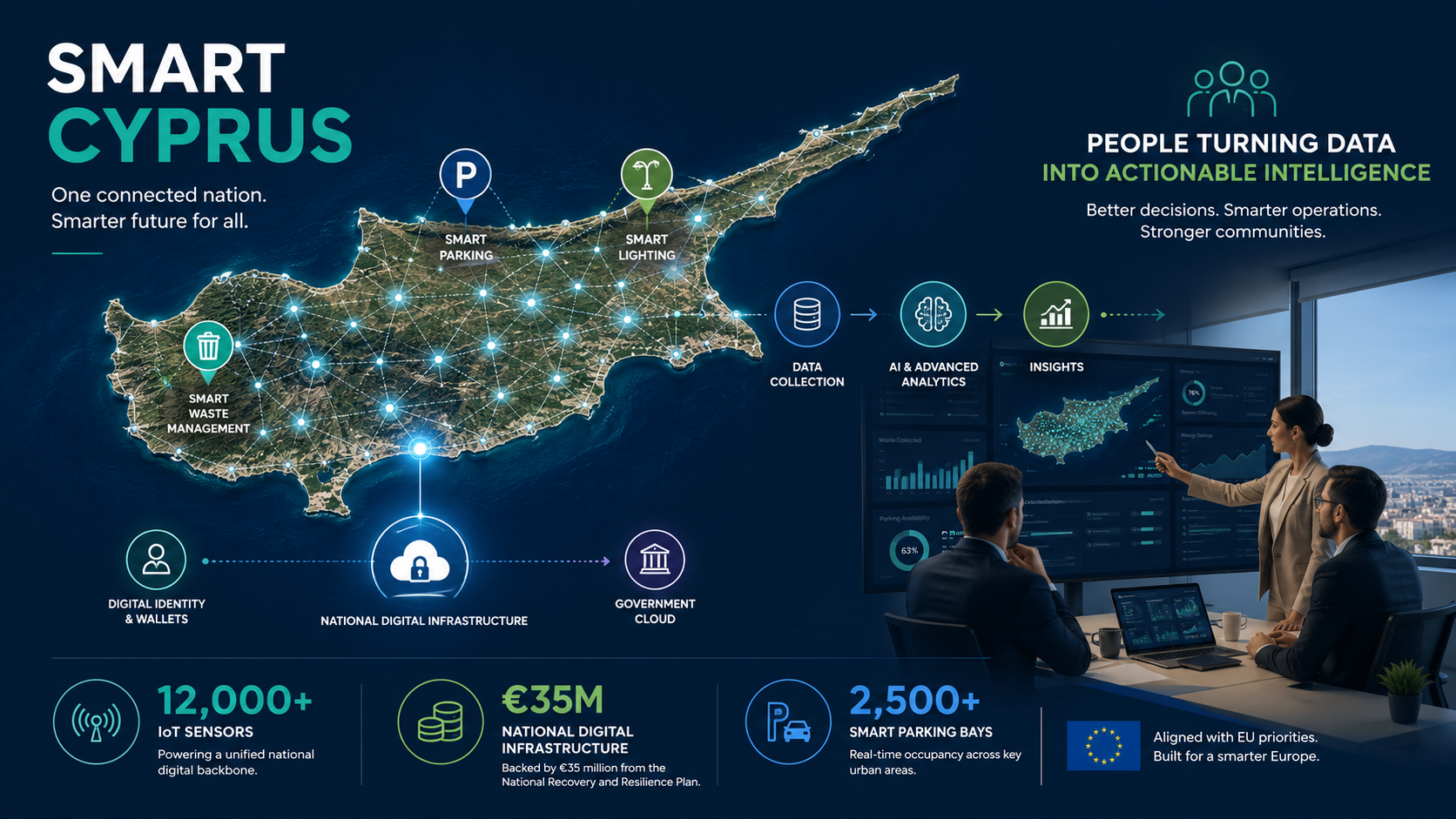
Drive through Limassol, Larnaca, Latsia or Yeri this summer and you will encounter the frontline of European digital policy and Internet of Things (IoT) deployment. Underneath more than 2,500 parking bays, real-time single-space IoT sensors report occupancy as part of a €5.17 million urban initiative. Nationally, over 12,000 IoT sensors power SMART CYPRUS, a unified national digital infrastructure backed by €35 million from the National Recovery and Resilience Plan.
For C-level executives, public sector leaders and digital policy strategists, Smart Cyprus represents a structural shift: moving away from fragmented municipal pilots and towards an integrated national digital backbone driven by Artificial Intelligence (AI), IoT and Smart Services.
But what is Smart Cyprus? Launched in July 2025 at Cyta's Nicosia headquarters, Smart Cyprus is a single national platform operated under a competitive tender. Unlike traditional decentralized initiatives, its initial rollout unifies three core Smart Services:
- Smart Parking powered by nationwide IoT sensors,
- Smart Lighting systems optimized for energy efficiency,
- Smart Waste Management linked via a unified citizen-facing mobile app.
Cyta's own framing at the launch was blunt: "We do not need ten different smart cities… we need one Smart Cyprus."
Interoperability, AI Strategy and National Digital Policy
That build-once-nationally logic is already widening. The Deputy Ministry of Research, Innovation and Digital Policy is rapidly connecting Smart Cyprus into a broader ecosystem of digital policy and identity tools:
- Digital Identity and Wallets: Integrating digital identity, e-invoicing and the Digital Citizen wallet, which has already passed 135,000 users.
- National Government Cloud: A national government cloud is due to begin implementation this September.
- National AI Strategy: A draft National Strategy for Artificial Intelligence, structured around eight objectives running to 2032, has just finished public consultation.
While debates surround the governance and implementation of national AI strategies, the strategic direction is unambiguous: Cyprus is constructing an enterprise-grade, interoperable digital platform.
Navigating EU Funding: Horizon Europe, LIFE and Digital Europe
That direction, as it happens, lines up closely with where EU funding priorities are heading this autumn. September is traditionally a dense month for Horizon Europe and LIFE deadlines, and 2026 is no exception. Key funding programmes are summarised in the table below:
|
EU Funding Programme |
Focus Area & Strategic Relevance |
Allocation / Deadline |
|
|
Energy communities and building renovation frameworks |
~€85.5 million (Closes 16 September) |
|
|
Digitalization, clean energy and smart mobility |
Key mobility topics (Closes 15 September) |
|
|
Local public administration pilots & data spaces |
European Data Space (Closes 1 Oct) |
To capitalize on these European opportunities, organizations should leverage primary administrative entry points, including the Cyprus Funding Programmes Portal and the Research and Innovation Foundation (the national contact point for Horizon Europe).
Strategic Implementation: Workforce Skills and AI Integration
Deploying IoT sensors, securing EU funding and drafting AI frameworks are prerequisites; however, operational success depends on workforce integration. Smart Services and AI strategies require professionals who can translate complex work programmes into scalable, fundable, real-world business models.
This execution layer is precisely where EUROCY operates. Focus areas include:
- Digital Inclusion & Accessibility: Long-standing partnerships (including projects with Ablebook and Cyta) to ensure inclusive digital access across platforms.
- AI for SMEs & Enterprise Transformation: Erasmus+ initiatives and HRDA-subsidised executive programs helping business leaders deploy AI and IoT directly into operations.
- Practical Capability Development: Advanced modules designed for operational decision-makers, rather than strictly technical engineers.
The ultimate ROI of Smart Cyprus will not be measured solely by the number of connected IoT sensors, but by how effectively decision-makers convert data streams into actionable intelligence and competitive advantage.
A training ecosystem is thus starting to grow around this landscape including HRDA vital importance seminars, such as the one running this October on applying AI and IoT to everyday operations.
Hence, the better measure of whether Smart Cyprus succeeds is probably not how many bays get a sensor; but how many people actually end up knowing what to do with the data those sensors produce.