Practical AI for Cyprus HoReCa SMEs: Three questions to ask before you adopt AI for Hospitality
Cyprus's hotels, restaurants and catering (HoReCa) businesses are under constant pressure to do more with less. Between unpredictable booking patterns, rising operating costs and staff already stretched thin across multiple roles, maintaining profitability is a daily challenge.
Artificial Intelligence (AI) is frequently pitched as the ultimate solution for hospitality SMEs. Yet, for most hotel owners, independent restaurateurs and catering managers in Cyprus, "AI" still feels abstract, or worse, like an expensive luxury, built exclusively for multinational hotel chains with dedicated IT departments.
Real Lessons from the HoReCa5.0 Project
Through our work as a partner in HoReCa5.0, an EU Erasmus+ funded programme (2022-1-BG01-KA220-VET-000089399) dedicated to enabling AI adoption among hospitality SMEs, we worked directly with Cyprus hotel directors, restaurant owners and food service managers. Our aim was simple; to separate genuine practical value from industry noise.
The hospitality businesses that successfully unlocked ROI from AI weren't the ones with six-figure budgets. They were the ones that prioritised operational clarity over technical complexity by asking three fundamental questions before adopting any (digital) tool:
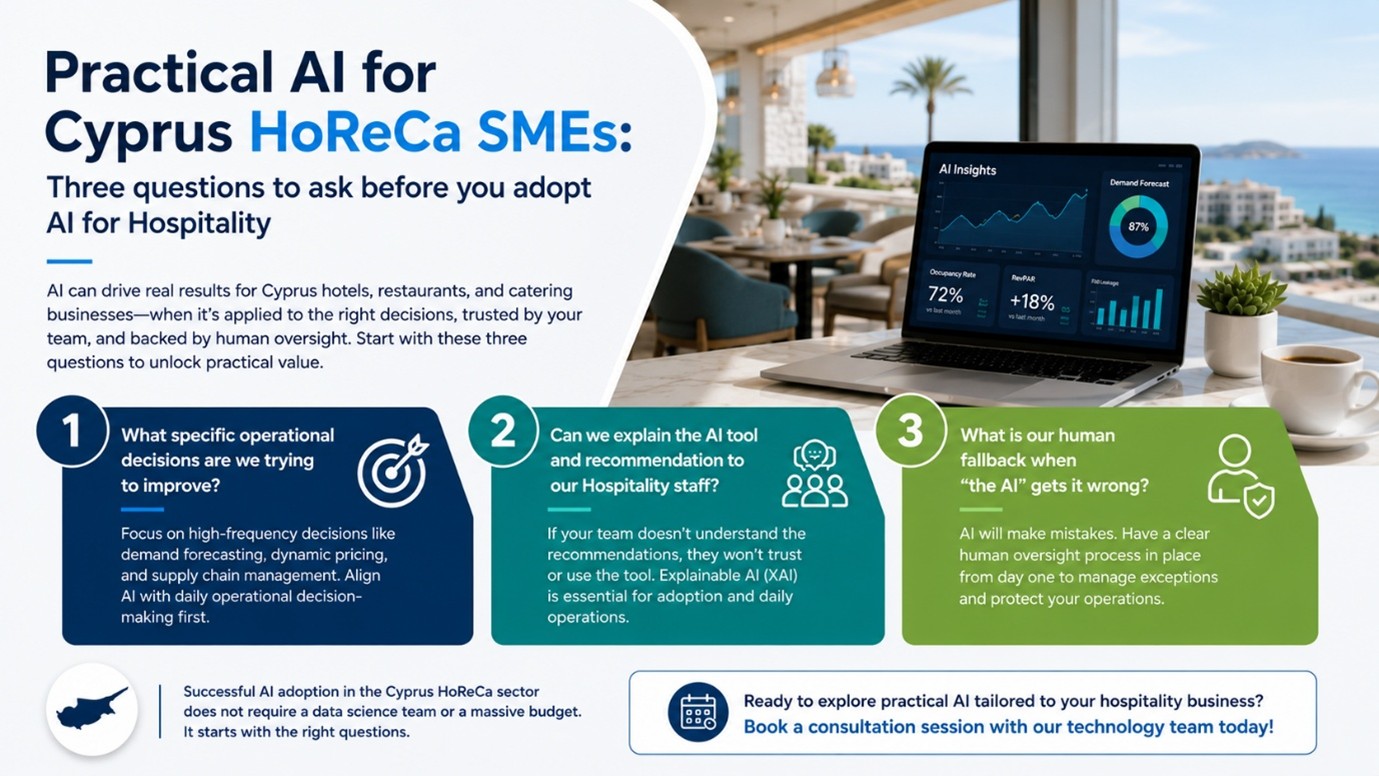
1. What specific operational decisions are we trying to improve?
AI is neither a standalone strategy, nor a magic bullet! For Cyprus HoReCa businesses, AI tools are only valuable when applied to specific, high-frequency operational decisions, such as:
- Demand and cover forecasting: How many covers to prepare for on a given evening to minimise food waste?
- Dynamic room pricing: Which rates to adjust during shoulder seasons to maximise occupancy?
- Supply chain management: Which local suppliers deliver optimal cost, quality, and delivery reliability?
If you cannot pinpoint the exact decision you wish to optimise, your business is not yet ready to choose data models or software. Always align technology with daily operational decision-making first.
2. Can we explain the AI tool and recommendation to our hospitality staff?
A crucial finding from our pilot sessions across the HoReCa5.0 project was that hospitality AI tools succeed or fail based on staff trust, not raw algorithmic accuracy.
If a forecasting tool generates recommendations that front-of-house staff or kitchen teams do not understand, they will simply ignore it, regardless of how sophisticated the underlying technology is. In the hospitality sector, Explainable AI (XAI) is not a technical luxury; it is the decisive factor determining whether a tool becomes part of daily operations or gets abandoned after a fortnight. If your team cannot understand why a tool made a suggestion, they won't act on it.
3. What is our human fallback when “the AI” gets it wrong?
Every AI tool will make a misjudgement at some point, whether miscalculating a sudden local event booking surge or misreading a quiet midweek turnover.
The Cyprus hospitality SMEs that navigated these glitches smoothly were those that established a clear human fallback process from day one. Instead of bolting on emergency protocols after an erroneous forecast wasted stock or inflated labour costs, these managers maintained human oversight at the core of their operational workflow.
Getting started with practical AI in Cyprus
Successful AI adoption in the Cyprus HoReCa sector does not require a data science department or a massive capital investment. It simply requires a clear understanding of your operational decisions and the confidence to ask what you are expecting the technology to achieve.
Ready to explore practical AI tailored to your hospitality business?